The short answer
Your recovery continues between appointments, not just during them. In a session we assess, treat, address the factors contributing to your problem and set your plan. The days in between are where your body adapts, your strength builds and your confidence comes back. If you are managing persistent, recurring or complex pain and wondering why progress feels slow, part of the answer usually sits in what happens across the rest of your week.
Your home exercise program is an essential part of your treatment, not simply homework between appointments. Physiotherapy sessions help us identify and address what is driving your problem, while your home program reinforces those changes and builds lasting strength, movement confidence and physical capacity. This article is for people who are motivated but feel uncertain or frustrated between visits. Sticking to a program is genuinely hard, and inconsistency is normal, not a personal failing. What follows is a practical conversation: how to fit the program around real life, what to do when an exercise feels wrong, and how to understand the purpose behind each one.
Why your home exercise program matters so much to your progress
Meaningful improvements can and do happen during treatment sessions. Lasting change, though, generally comes from repeated, consistent work over time. Your tissues, your strength and your movement patterns adapt in response to regular stimulus, and one weekly session cannot deliver enough of that on its own.
Think of it this way. In a session we watch how you move, work out what is likely driving your problem, use hands-on treatment and movement retraining where it helps, explain what is going on, and set or adjust your program. That is real work, and it matters. Your home program then reinforces those changes. The stronger tendon, the more resilient muscle, the nervous system relearning that a movement is safe: much of that is built in the repetitions you do between appointments. The two work together.
This matters even more with persistent or recurring pain. When pain has been around a long time, there is rarely one structure or quick fix responsible. Recovery usually depends on gradually rebuilding capacity and confidence through consistent, graded activity, and that is something only you can do, day by day, in your own kitchen or lounge room. Once you see the home program as an essential part of your treatment rather than an optional extra, the exercises stop feeling like a chore you keep meaning to get to.
How many times a day or week should you actually do your exercises?
The right frequency depends on the type of exercise and the goal behind it, so there is no single number that suits everyone. As a general guide, strength and capacity work is usually done every second or third day to allow recovery, while mobility, control and pain-settling exercises can often be done daily or even a few times a day.
Here is a simple way to sort them:
- Strength and loading exercises: typically two to three times per week, with a day of recovery between. Muscles and tendons adapt during rest, not only during effort.
- Mobility and movement control work: often daily, because these are about building a habit and reminding your body how to move comfortably.
- Pain-settling exercises: sometimes several short bouts across the day, especially early on when you are calming an irritable area.
- Walking and general activity: most days, built gradually, as part of restoring overall capacity. A loop around Birchgrove or a stretch of the Bay Run counts.
If you are not sure which category an exercise falls into, ask us at your next session. Consistency across the week matters far more than being perfect on any given day. Three solid sessions beat seven rushed, distracted ones. Miss a day and you have not undone anything. You just pick it back up. Your physiotherapist will recommend the most appropriate frequency based on your individual needs, the type of exercise and how your body responds. These are general guides, not fixed rules. More exercise is not necessarily better, and adequate recovery is an important part of rehabilitation.
Does how you do an exercise matter as much as how often?
Yes. How you perform an exercise can be just as important as how often you do it. Your physiotherapist may prescribe specific movements to address areas of reduced mobility, improve coordination or change how different parts of your body work together. These are often subtle, and they are easy to lose once you are practising on your own.
Taking the time to understand and practise these movements correctly makes your home program more effective. Slow down, follow the cues we gave you, and if something does not feel the way it did in the clinic, ask. A few well-performed repetitions usually do more than many rushed ones
What should you do if an exercise feels wrong, painful or too hard?
Some discomfort during rehabilitation can be normal, particularly when rebuilding strength or capacity. However, the amount and type of discomfort that is acceptable will depend on your condition. Your physiotherapist can help you understand what symptoms are expected, what is safe to work through and when an exercise should be modified. As one example, a guideline we sometimes use is that mild discomfort during and shortly after exercise is often fine, provided it settles within about 24 hours and is not building session to session. That will not suit every condition, so we will tell you what applies to you.
If an exercise feels wrong, work through this before you abandon it:
- Check the setup. Small errors creep in once you are on your own at home. Revisit the cues we gave you, slow the movement right down, and film yourself on your phone if that helps. Bring the video to your next appointment so we can see what you are seeing.
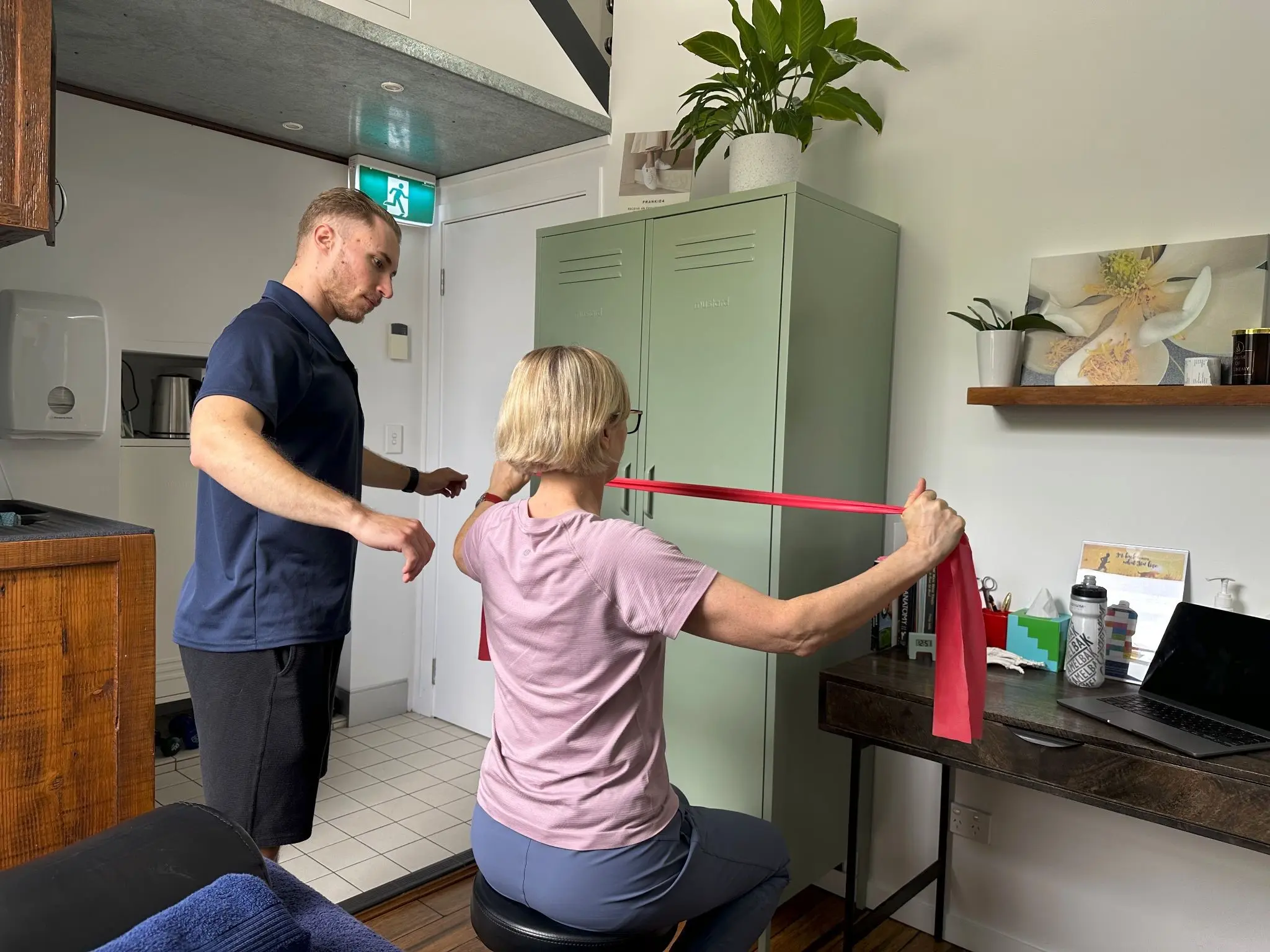
- Reduce the load or range. You can almost always make an exercise easier. Fewer repetitions, a lighter TheraBand, a smaller range, more support against a wall or chair. An easier version done well beats a hard version done badly.
- Notice the type of sensation. A working, fatiguing, slightly achey feeling in a muscle is usually fine. Sharp, pinching or pain that lingers into the next day is worth flagging.
- Do not grind through sharp pain. Pushing into genuine pain rarely speeds things up, and it often sets you back.
Struggling with an exercise does not mean something is wrong with your body or that you are failing. It usually means the exercise needs tailoring to where you are right now. That is exactly the kind of thing worth raising rather than quietly giving up on.
How to build a routine that fits around real life (not the other way around)
The most effective home program is the one you will actually do. That means it has to fit your life, not demand that you rebuild your life around it. Consistency comes from making exercises small, specific and anchored to things you already do each day.
A few strategies that tend to work:
- Anchor exercises to existing habits. Do your ankle mobility while the kettle boils. Do your balance work while you brush your teeth. Attaching a new habit to an established one makes it stick.
- Lower the bar on hard days. On a busy or flat day, one set of one exercise beats nothing. A little keeps the habit alive.
- Keep the gear visible. A resistance band left on the kitchen bench gets used. The same band buried in a drawer does not.
- Schedule it like an appointment. Block a short, realistic window rather than waiting to find time, which rarely turns up on its own.
- Spread it out if that suits you. The program does not have to happen in one block. Two or three short bouts across the day can be easier to fit in and, for many goals, just as effective.
Motivation will come and go. That is human. Systems and habits carry you through the stretches when motivation is low, which is most of the time, for most of us.
How to track your progress between sessions so your physio can help you more effectively
Simple tracking turns an appointment from guesswork into an informed decision, because it gives us real information about how your week actually went. Without it, we are relying on memory, and memory blurs across seven days.
You do not need anything elaborate. A note in your phone is plenty. Things worth jotting down:
- Which exercises you did, and how many days you managed them
- Things you can now do more easily: walking further, sleeping through the night, lifting the shopping you had been avoiding
- Activities you feel more confident with, or still feel hesitant about
- How the area felt during and after, and whether any soreness settled
- Any activity that flared things up
- If it helps, a quick note on symptoms at a consistent moment, such as first thing in the morning
This record helps us see the trend, work out what is helping, and adjust with more precision. It also helps you spot progress that is easy to miss day to day, which matters when recovery is gradual and your attention naturally lands on what still hurts rather than what has quietly improved.
Common reasons people stall between sessions and how to work through them
Most plateaus come down to a handful of practical issues, and nearly all of them are solvable once you name them. Stalling rarely means your body is broken or that recovery is off the table for you.
Common reasons progress stalls:
- The program has outgrown its challenge. As your strength and capacity improve, your exercises may need to progress. Your physiotherapist can help determine when and how to increase the challenge while making sure you are maintaining good movement quality and responding well. That is a sign to review the program together, not a problem with you.
- Inconsistency, often for understandable reasons. Life gets busy, pain flares, motivation dips. Honest tracking usually reveals this, and the fix is adjusting the routine, not pushing harder through guilt.
- Fear of making things worse. Many people with persistent pain hold back because they worry movement is doing damage. Understanding why an exercise is safe and appropriate often unlocks the confidence to do it properly.
- Doing too much, too soon. The opposite problem. Big jumps in load or activity can cause flare-ups that feel like going backwards. Steady, graded progression works better.
- Expecting a straight line. Recovery is rarely linear. Good weeks and harder weeks are both normal, and a flare does not erase what you have built.
If you feel stuck, that is genuinely useful information for us, not a reason to lose heart. A plateau is usually a cue to reassess and adjust. That is what sessions are for.
When to contact your physiotherapist before your next scheduled session
You do not have to wait for your next appointment if something changes or you are unsure. Reaching out early often stops a small issue becoming a larger setback, and it is always reasonable to check in.
It is worth contacting us before your scheduled session if:
- Pain is getting noticeably worse over several days rather than settling
- A new or different symptom appears that you were not expecting
- You feel stuck, unsure whether you are doing an exercise correctly, or have lost confidence in the plan
- An exercise consistently causes sharp pain that does not settle within a day
- Something in your life has changed and the program no longer feels realistic
Seek urgent medical assessment, rather than waiting, if you notice new bladder or bowel dysfunction, or significant or progressive neurological symptoms such as numbness, tingling or weakness that is spreading or worsening. Also seek prompt medical attention for severe unremitting pain or feeling generally unwell alongside your symptoms. These are uncommon, but they are worth knowing. For everyday uncertainty, a quick message or an earlier appointment is usually all it takes to get you moving in the right direction again.
How your home program fits into the bigger picture of recovery and long-term strength
Your home program is not only about settling your current problem. It is the foundation of becoming stronger, more capable and more confident than you were before the pain started. The exercises you do between sessions are the same habits that, over time, support lasting health and independence.
At Redo Health we think about recovery as a journey rather than a single fix: understanding what is driving your problem, recovering and rebuilding confidence, developing strength and capacity, returning to the activities that matter, then maintaining all of that for the long term. Your home program runs through every one of those stages. Early on it helps calm and restore. Later it shifts towards genuine strength and resilience, so the problem is less likely to return.
For many people, especially those managing persistent pain, osteoarthritis, osteoporosis or the changes that come with healthy ageing, this is where real independence is built. The aim is not to do rehab exercises forever. It is to develop sustainable movement and strength habits that keep you doing what you love. As you progress through rehabilitation, your physiotherapist may recommend transitioning into individual Exercise Physiology sessions or our small-group clinical exercise classes. Both provide opportunities to continue developing strength, confidence and physical capacity, with the level of supervision and support tailored to your needs. For some, a healthy bones program is another good next step once the acute phase has passed.
If you are working through a home program and want clearer direction, a proper assessment, or support staying on track between sessions, we would be glad to help. Learn more about our Physiotherapy and Exercise Physiology services, or get in touch with our team to arrange a time to talk through where you are and where you want to get to.
This article is general information only and not medical advice. Speak with a qualified practitioner about your individual circumstances.